
Last updated:
A GoHighLevel consultant is not the same as a GoHighLevel builder, and confusing the two is the most expensive mistake in this market.
A builder makes the thing you asked for. A consultant tells you whether you asked for the right thing. One saves you hours. The other saves you months.
This guide explains what a GoHighLevel consultant really does, when you need one, what it costs, and how to tell in one call whether the person across the table has actually run these systems in real businesses.
What a GoHighLevel consultant does
The job starts before anything is built.
A GoHighLevel consultant looks at how leads reach you now, where they go cold, what your team does by hand every day, and what you are paying for in other software. Then they design the system on paper and tell you what to build first.
Typical work includes all of this.
- Auditing your current setup and listing what is broken, unused or duplicated
- Designing your pipeline around how your team really sells
- Deciding what should be automated and, more importantly, what should not
- Planning the move off your old tools without a gap in follow up
- Choosing the right plan and features so you are not paying for room you never use
- Training your team and writing down how the system works
Notice how little of that is clicking inside software. That is the point.
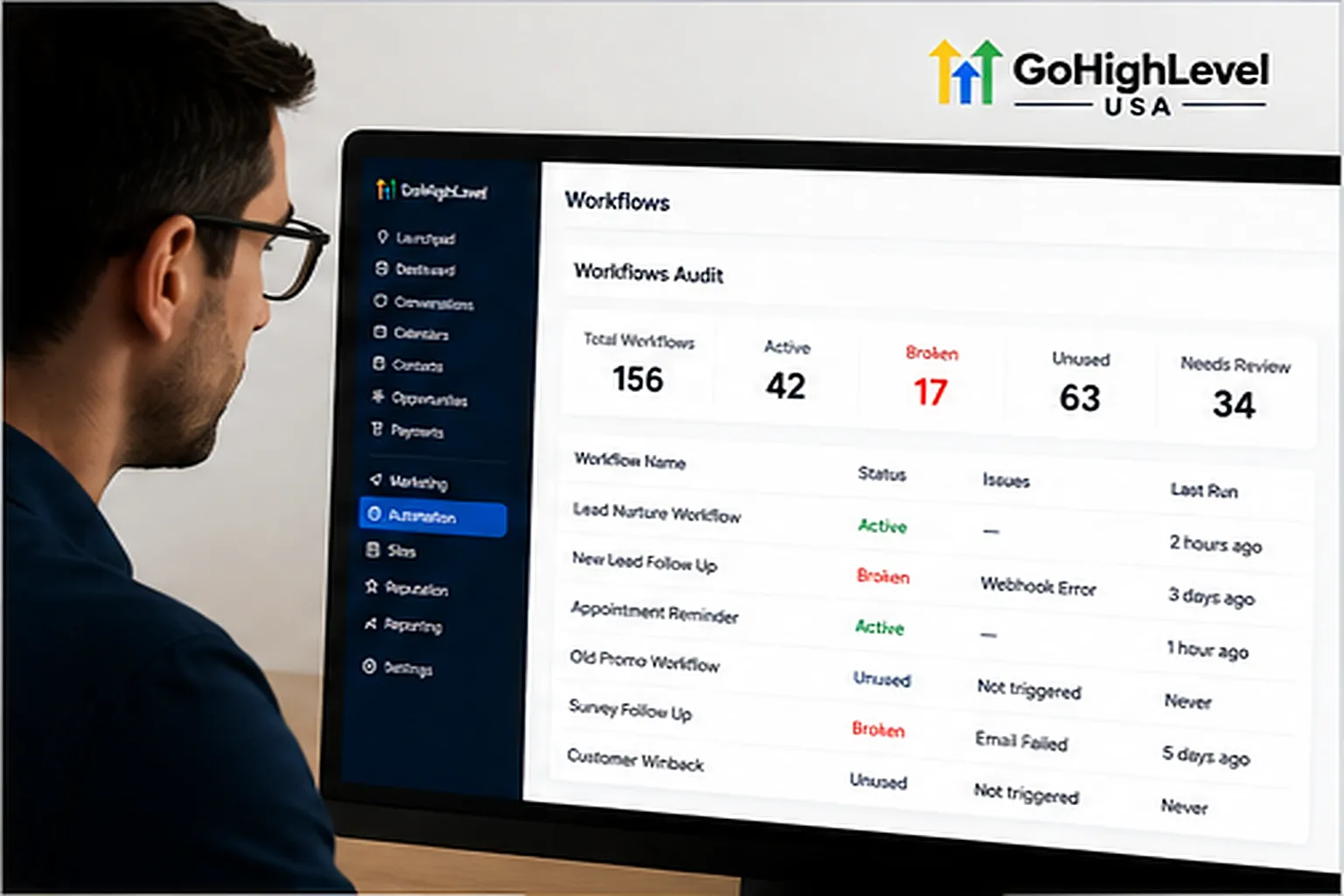
What a GHL consultant delivers: the audit and roadmap
A GHL consultant should leave you with documents, not just advice on a call. The audit shows what is true today, and the roadmap says what to change and in what order.
When we audit an existing GoHighLevel account, these are the areas we check.
| Area | What gets checked |
|---|---|
| Pipelines | Whether stages match how the team really sells, and whether old pipelines are still collecting deals |
| Workflows | Which are active, which overlap, which fail, and which nobody can explain |
| Messaging compliance | A2P 10DLC brand and campaign status, opt-out handling, and sending domain authentication for email |
| Contact data | Duplicates, unused custom fields, missing sources and blank required fields |
| Calendars | Time zones, availability, team assignment and reminder timing |
| Reporting | Whether lead source, response time and booked appointments can be measured at all |
| Plan and billing | Plan fit, usage charges, unused add-ons and tools that could be cancelled |
| Users and access | Admin users, former staff still active, and integration tokens nobody owns |
What the roadmap should include
The roadmap that follows should rank changes by impact and effort. It should also name who owns each item after handover, because a plan without an owner rarely gets finished.
- The target pipeline stages and who is responsible for each one
- Automations in priority order, with the outcome each one is meant to produce
- Tools to retire, and the order to cancel them so follow up never stops
- Compliance items such as A2P registration and consent capture
- The few numbers you will track to see whether the changes worked
Messaging is often where an audit finds the most urgent problems. If your A2P registration is stuck or rejected, our GoHighLevel A2P help page explains what usually causes it.
New to GoHighLevel? Try it free for 30 days
HighLevel's standard free trial is 14 days. Through our partner link you get 30 days plus HighLevel's free onboarding bootcamp. Rather have it built for you? Our US team sets up GoHighLevel accounts, websites, funnels and automations.
Partner link: we may earn a commission at no extra cost to you. Disclosure
When you need a GoHighLevel consultant
Four situations make the cost of a GoHighLevel consultant obvious.
You already have GoHighLevel and it is a mess. Six half finished workflows, three pipelines nobody agrees on, and messages firing at the wrong time. Building more on top of that makes it worse. Somebody needs to untangle it first.
You are about to migrate. The worst migrations copy an old broken process into a new platform. A little planning here saves weeks of rework.
Your team will not use it. This is almost never a software problem. It is usually a process that does not match how people actually work.
You are scaling to multiple locations or clients. What works for one account falls apart at ten unless the structure was designed for it.
If none of those describe you, and you simply need a system built, you may only need a builder. That is a cheaper conversation and an honest consultant will say so.
GoHighLevel consulting for agencies vs single businesses
The same title covers two quite different jobs. Ask any consultant which kind of client they mostly work with.
Single businesses
For one business, consulting is about lead flow and adoption. How fast new leads get a reply, who owns follow up, which tools GoHighLevel can replace, and whether the team will actually use the CRM every day.
The deliverable is usually one well designed account, a short training plan and a list of the reports the owner should read each week.
Multi-location businesses sit in between. Each location usually needs its own sub-account settings, but naming, reporting and standards should be shared so the owner can compare locations fairly.
Agencies
For an agency, consulting is about structure that repeats. That means snapshot strategy, how sub-accounts are named and permissioned, client onboarding steps and how usage costs are passed on to clients.
Plan choice matters more here. HighLevel includes SaaS Mode, automated sub-account creation and rebilling of phone and email usage with markup only on Agency Pro, so a consultant should confirm which of those you need before you upgrade.
An agency consultant should also ask about white label, support coverage and what happens when one client leaves. Those answers shape the account structure more than any single workflow does.
Consultant, setup expert, or developer?
Three roles, three price tags, and constant confusion between them.
A GoHighLevel consultant decides what should exist and why. Strategy, structure and sequencing.
A setup expert builds it inside the platform. Funnels, workflows, calendars, pipelines, compliance and imports.
A developer writes code that connects GoHighLevel to software it was never built to talk to. Our guide on how to hire a GoHighLevel developer explains when that is genuinely needed, which is less often than people think.
Many good providers do the first two together. Very few do all three well, and anyone claiming to be excellent at all three is worth a second look.
What a GoHighLevel consultant should ask you
Here is the test. In a first call, a real GoHighLevel consultant asks more than they tell.
Expect questions like these. How many leads do you get a week and where do they come from? How fast do you reply now? Who picks up the phone? What happens when nobody does? Which tools are you paying for, and what does each one actually do? What does your team do every morning? What has been tried before and why did it stop?
If the first call is a pitch instead of an interview, you are speaking to a salesperson. That is not a crime, but price it accordingly.
What it costs to hire a GoHighLevel consultant
There are three common shapes.
A one off audit. A few hours of review and a written plan you can hand to any builder. This is the cheapest useful thing you can buy and it often saves more than it costs.
Consulting plus build. The same person plans and then delivers. Most businesses choose this because accountability sits in one place.
Ongoing advisory. A monthly arrangement for agencies and multi location businesses that keep changing.
Rates vary widely. Freelance marketplaces show a very wide spread of hourly rates for GoHighLevel help, but most of those profiles offer platform help rather than strategy work. Experienced US consultants usually price by project, with cost driven by how many pipelines, workflows, locations and replaced tools are in scope.
Remember the platform sits on top. The official HighLevel pricing page lists Starter at $97 a month, Unlimited at $297 a month and Agency Pro at $497 a month, with a 14 day free trial.
How to test a GoHighLevel consultant in one call
Four questions separate a real GoHighLevel consultant from someone who finished a course last month.
Ask about A2P 10DLC. In the United States you must register before text messages deliver reliably. Anyone who has launched real accounts will discuss brand and campaign registration without pausing. This single question filters out many inexperienced providers.
Ask what a snapshot does not include. A correct answer mentions that contacts, conversations, appointments, reputation data, Stripe connections and integrations do not travel. That is documented behaviour in the official HighLevel snapshots guide, so the answer is either right or it is not.
Ask how they handle duplicate contacts on import. A real answer mentions cleaning the file before import and knowing that matching runs Contact ID first, then email, then phone.
Ask what they would not automate. Experienced people always have an answer, usually around anything that should stay a human conversation. People with no scars want to automate everything.
What a good GoHighLevel consultant engagement looks like
The shape is fairly standard across serious providers, and a good GoHighLevel consultant will name these stages upfront.
Audit. Someone goes through your current setup and lists what exists, what is used and what is broken. Nothing is built yet.
Plan. You agree the pipeline, the automations, what gets retired and the order of work. This is the stage people rush and the one that decides everything.
Build. Fields, imports, workflows and compliance. A2P registration starts early so it has time to be approved.
Test. Real leads through real forms. Emails checked for inbox placement. Reminders checked against your time zone.
Handover. Training, documentation and an agreed support window.
If a proposal jumps straight from the first call to building, ask why. The plan is where the money is saved.
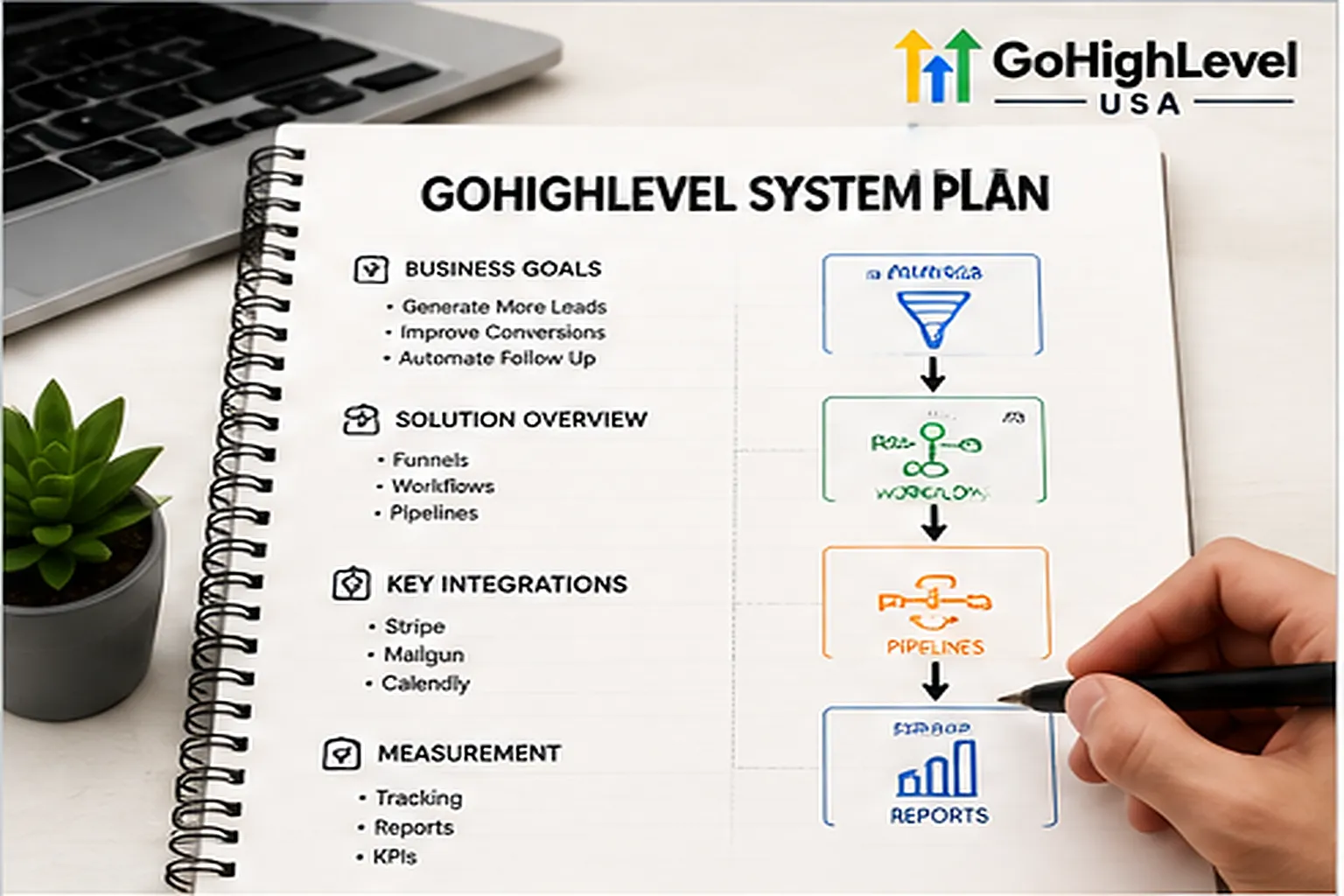
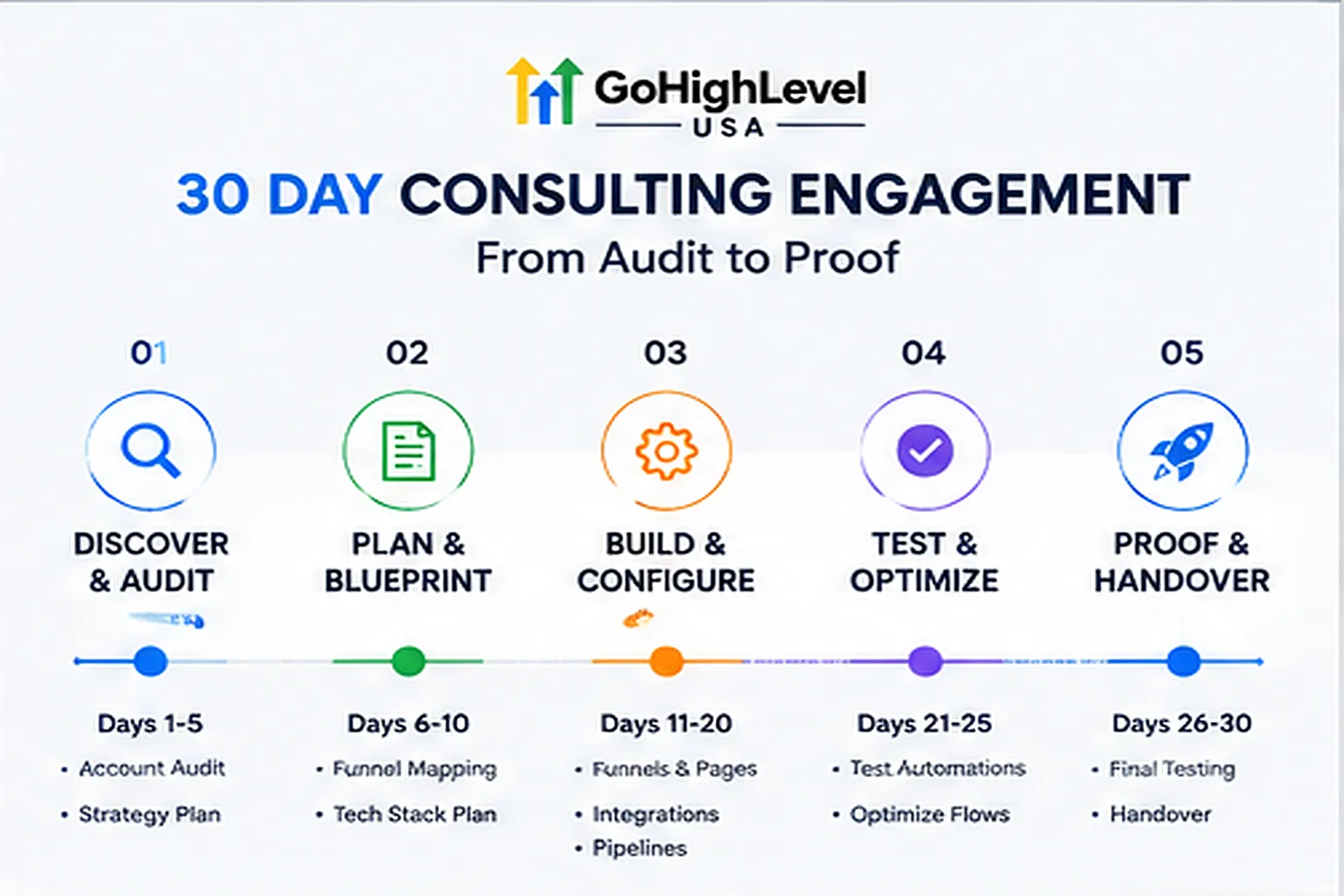
What to expect in the first thirty days
Good consulting shows up as decisions, not as activity. Here is a realistic month.
Week one is listening. Calls with you and with whoever answers the phone. A look inside your current account, your inbox and your calendar. No building. If someone starts building in week one, they are guessing.
Week two is the plan. A written document you could hand to any builder. It names the pipeline stages, the automations in priority order, what gets retired, and which tools get cancelled. You should be able to read it and disagree with parts of it, which is exactly why it exists.
Week three is the first build. Not everything. The one automation that makes money, usually new lead follow up, plus the forms and calendar feeding it. A2P registration starts here so it has time to be approved.
Week four is proof. A real lead travels from form to booked appointment while you watch. Numbers get compared against the old system. Only then does the rest of the build continue.
If a proposal cannot describe a month in this much detail, ask for one before you sign anything.
GoHighLevel consultant red flags
- A fixed price quoted before anyone has looked inside your account
- Building in their agency account rather than yours
- No mention of A2P registration anywhere
- Promising features GoHighLevel does not have
- Full payment demanded before any work is delivered
- No documentation or recorded walkthrough at handover
- Automating a process nobody has agreed on yet
That last one is the quiet killer. Automating a broken process just breaks it faster.
What a GoHighLevel consultant cannot fix
Be honest with yourself before you spend anything.
No consultant can fix a weak offer. If people are not replying, the problem is usually what you are saying rather than how it was sent.
No consultant can fix a list full of dead numbers and blank fields. Clean data first, automate second.
And no consultant can fix a team that will not open the CRM. That is a management decision, and the best ones will tell you so in the first call rather than take your money.
Frequently Asked Questions
What is a GHL consultant?
A GHL consultant is a GoHighLevel specialist who plans how the platform should be used before anything is built. The work covers auditing your account, designing pipelines, ranking automations by priority, planning migrations and choosing the right plan. The output is a written roadmap that a builder, your team or the consultant can then carry out.
How is a GoHighLevel consultant different from a developer?
A consultant decides what should exist and why. A developer writes code to connect GoHighLevel to software it cannot reach natively, using the API, webhooks or custom code. Most businesses need a consultant or setup expert first. A developer only makes sense once the plan shows a gap that the platform itself cannot fill.
Can a GoHighLevel consultant work inside my existing account?
Yes, and they should. The consultant should be added as a team user in your own account with only the permissions the audit needs, not given your owner login. When the engagement ends, remove that user. Building in your account rather than theirs also means you keep everything when the work is done.
Do I need a consultant if I bought a snapshot?
Often, yes. A snapshot copies configuration such as funnels, workflows, pipelines and custom fields, but not contacts, conversations, integrations or Stripe connections. Someone still has to adapt it to your offer, connect your tools, register A2P and check that every automation fits how your team works.
Your next step
Before you book anyone, write two short lists. What your team does by hand every day, and every tool you currently pay for. Those two lists are the core of a good audit and they cost you nothing.
Then bring them to a call and see whether the person asks better questions than you expected. If you want us to run that audit with you, see our GoHighLevel setup service page, or read what a full done for you GoHighLevel setup should include before you pay anybody.