
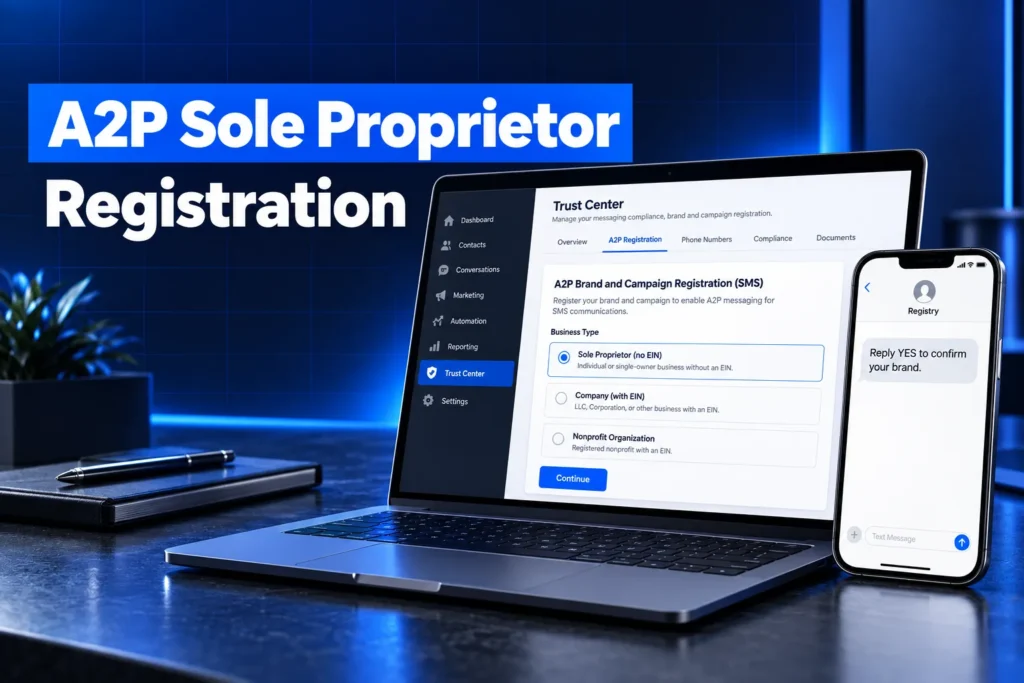
An A2P 10DLC sole proprietor brand is the registration path for US businesses that have no EIN or other tax ID. It lets you text from a local 10-digit number after a one-time-password check. It is capped at one campaign, one phone number and one message per second.
This guide explains who qualifies as a sole proprietor brand and how it compares with a standard brand. It covers the limits that matter day to day and what you need to register in GoHighLevel. It also lists the mistakes that cause rejections and when you should get an EIN and upgrade. It is general information, not legal advice; confirm anything specific to your business with counsel.
What is an A2P 10DLC sole proprietor brand?
An A2P 10DLC sole proprietor brand is a lightweight brand registration with The Campaign Registry (TCR). It is for individuals and small businesses without a business tax ID. Identity is confirmed through a text to the owner’s personal mobile number instead of an EIN check against IRS records.
A2P 10DLC stands for application-to-person messaging over 10-digit long codes, the ordinary local numbers most US businesses text from. US carriers require every business that texts from these numbers to register a brand and a campaign. The brand is who is sending. The campaign is what they send and how people opt in.
- Standard brands are verified against an EIN and the legal business name on IRS records, such as the CP575 or 147C letter.
- Sole proprietor brands skip the EIN and verify the person instead, through a one-time password (OTP) sent to their mobile phone.
- Both live in the same place in GoHighLevel: the Trust Center inside the sub-account’s phone settings.
Who qualifies as an A2P 10DLC sole proprietor?
You qualify for A2P 10DLC sole proprietor registration only if your business has no EIN or other tax ID. HighLevel’s changelog states that customers with a tax ID are not eligible. They should register a Low Volume Standard or Standard brand instead. Only US addresses are now accepted.
The label is about tax identity, not about how small you are. Many one-person businesses already have an EIN because they opened a business bank account, hired help or formed an LLC.
- Good fit: a solo coach, tutor, photographer, cleaner or contractor operating under their own name with no EIN.
- Not eligible: any LLC, corporation, partnership or nonprofit with an EIN, even if it is a single-member LLC.
- Not eligible: a business that has an EIN but prefers the simpler form. TCR can check, and a mismatch leads to rejection.
Registering as a sole proprietor when you have an EIN is one of the patterns we see cause avoidable rejections. If you are unsure, check your IRS paperwork first.
New to GoHighLevel? Try it free for 30 days
HighLevel's standard free trial is 14 days. Through our partner link you get 30 days plus HighLevel's free onboarding bootcamp. Rather have it built for you? Our US team sets up GoHighLevel accounts, websites, funnels and automations.
Partner link: we may earn a commission at no extra cost to you. Disclosure
How does a sole proprietor brand compare with a standard brand?
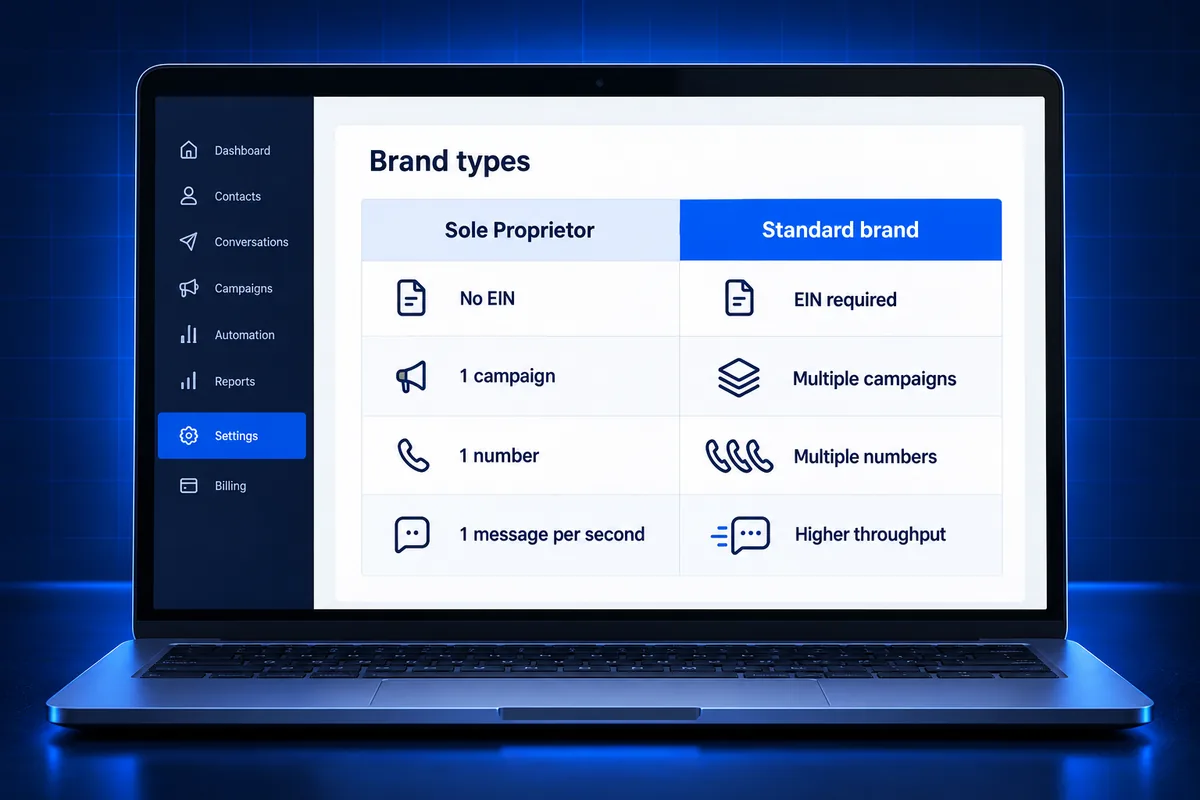
A sole proprietor brand trades capacity for simplicity. It needs no EIN, but it allows one campaign, one phone number and one message per second. A standard brand needs an EIN that matches IRS records, and in return supports multiple campaigns and numbers with higher throughput.
For a field-by-field comparison, see A2P Ready’s sole proprietor vs standard brand guide.
| Feature | Sole proprietor brand | Standard brand (EIN) |
|---|---|---|
| Tax ID required | No (not allowed if you have one) | Yes, EIN matching IRS records |
| Identity check | OTP sent to the owner’s personal mobile | Legal name and EIN matched by TCR |
| Campaigns per brand | 1 | Multiple |
| Phone numbers per campaign | 1 | Multiple |
| Throughput | 1 message per second | Higher, based on brand vetting |
| Use case | Single “Sole Proprietor” use case | Marketing, mixed, notifications and others |
| Best for | Small, low-volume senders | Growing businesses and multi-location teams |
A third option, the Low Volume Standard brand, is for businesses that do have an EIN but send modest volumes. It uses the EIN path with lower registration overhead than a full standard brand.
What are the limits of a sole proprietor brand?
A sole proprietor brand is limited to one campaign per brand, one phone number per campaign and one message per second. Twilio’s brand documentation also lists a T-Mobile daily cap of about 1,000 SMS segments for sole proprietor brands, so it suits low-volume, conversational texting only.
- One number: you cannot attach a second local number for another location, a sales line or a marketing line.
- One campaign: you cannot split marketing and appointment reminders into separate registered campaigns.
- One message per second: a 300-contact text blast queues for several minutes rather than sending at once.
- Daily caps: long messages count as several segments, so the daily allowance runs out faster than the message count suggests.
Mobile number and email reuse limits
The personal mobile number used for the OTP can be used no more than three times across all A2P brand registrations with TCR. HighLevel and Twilio both state this limit. Twilio also caps the same email address at 10 brand registrations. Registrations through other providers count toward these limits.
This matters for agencies registering several solo clients. Never reuse your own mobile number or email for a client’s sole proprietor brand; each client must use their own.
What do you need to register a sole proprietor brand?
To register a sole proprietor brand you need your full name, the business name you trade under, an email address and a valid US physical address. You also need a personal US mobile number that can receive the verification text. The campaign needs a compliant opt-in flow and sample messages.
- Personal mobile number: it cannot be a number bought from a provider such as LeadConnector or Twilio. HighLevel’s changelog is explicit about this.
- Accurate identity details: first and last name, business name, email and address must be real and consistent.
- A website or opt-in page: carriers review how people agree to receive texts, so the consent wording must be visible.
- Privacy policy and terms: with an SMS section that says mobile numbers and consent are not shared with third parties for marketing.
- Sample messages: realistic texts that include your business name and opt-out instructions.
The opt-in wording is the part most often rejected. Our guide to SMS opt-in language has compliant examples you can adapt for forms and chat widgets.
How does sole proprietor registration work in GoHighLevel?
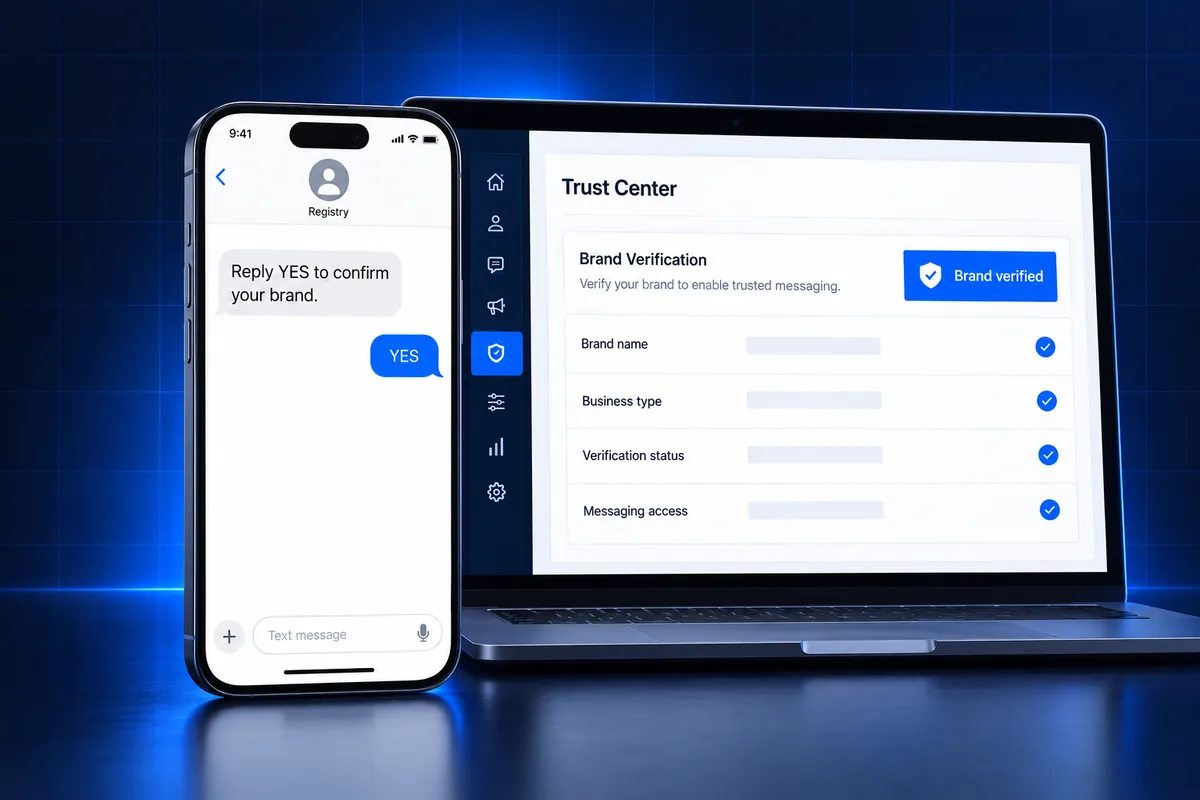
In GoHighLevel, sole proprietor registration starts in the sub-account’s Trust Center under phone number settings. You choose the sole proprietor option, enter your details and reply YES to the verification text sent to your mobile. Once the brand is approved, the campaign is submitted for carrier review.
- Open the Trust Center: Sub-Account Settings, then Phone Numbers, then Trust Center.
- Start registration: on the A2P Brand and Campaign Registration (SMS) card, choose the sole proprietor option, shown when you indicate the business has no EIN.
- Enter details: name, business name, email, US address and your personal mobile number.
- Confirm the OTP: reply YES to the text from TCR. Twilio’s documentation gives 24 hours to respond; if the window passes, you can trigger a new request.
- Campaign review: after the brand is approved, the campaign is submitted automatically and goes through manual vetting.
What does sole proprietor registration cost?
HighLevel’s changelog lists a one-time sole proprietor brand fee of $4.41, a one-time campaign vetting fee of $16.55 and a monthly campaign fee of $2.25. These are carrier and registry pass-through fees, and they can change. A rejection still costs you days without texting, so get it right the first time.
What mistakes get sole proprietor registrations rejected?
Most sole proprietor registrations fail for avoidable reasons. The business may have an EIN, or the OTP text was never answered. The mobile number may be a provider number, or the opt-in flow and sample messages do not match. Each failure means more waiting before you can text.
- Using a LeadConnector or Twilio number for the OTP. It must be a real personal mobile.
- Missing the verification text. The brand cannot be approved until you reply YES.
- Reusing a mobile number or email that has already hit its registration limit.
- Weak opt-in evidence: no consent checkbox, missing STOP and HELP wording, or no privacy policy link.
- Sample messages that do not match the use case, such as promotional blasts for a brand described as appointment reminders.
- Prohibited content: categories carriers restrict, such as certain loan, cannabis or third-party lead offers, are rejected regardless of brand type.
If a campaign has already come back rejected, our GoHighLevel A2P help guide walks through the common rejection reasons and what each one means.
When should you get an EIN and upgrade to a standard brand?
Get an EIN and move to a standard or Low Volume Standard brand when you need a second number or separate marketing and reminder campaigns. Faster sending and higher daily volume are other reasons. An EIN is free from the IRS, and the upgrade removes the single-number, single-campaign ceiling.
- You are adding a second location, a team member’s line or a dedicated sales number.
- You use missed-call text-back, reminders and marketing at the same time and want each registered properly.
- You plan to run Conversation AI or other always-on texting that needs reliable throughput.
- You formed an LLC, which normally means you now have an EIN and are no longer eligible for the sole proprietor path.
For standard brands, the legal name must match the IRS record on your CP575 or 147C letter exactly. Our A2P 10DLC registration service guide explains the EIN brand path, fees and timelines in more detail.
If texting is too limited for your volume, toll-free numbers are a separate route with their own verification. See our toll-free verification guide to compare.
Want your A2P registration done right the first time?
A rejected campaign costs more days without texting. Our GoHighLevel A2P 10DLC registration service checks which brand type you qualify for and reviews your opt-in page and sample messages. Then it submits for a $50 flat service charge plus carrier fees, with prep in 24 to 48 hours.
Once texting is approved, put your one number to work with missed-call text-back and speed-to-lead, which replies to callers you could not answer.
Frequently Asked Questions
Here are short answers to the questions solo business owners ask most about A2P 10DLC sole proprietor registration. They cover registering without an EIN, single-member LLCs, sending limits, the verification text and upgrading later. This is general information, not legal advice, so confirm anything specific with counsel.
Can a sole proprietor register for A2P 10DLC without an EIN?
Yes. The sole proprietor brand type exists for US businesses with no EIN or other tax ID. Instead of an IRS match, The Campaign Registry confirms your identity with a one-time password sent to your personal mobile number. You get one campaign and one phone number, which is enough for many low-volume solo businesses.
Can a single-member LLC use sole proprietor registration?
Usually not. A single-member LLC that has an EIN is not eligible. HighLevel states that customers with a tax ID must use a Low Volume Standard or Standard brand. The sole proprietor path is for businesses with no tax ID at all. Using it with an EIN on file risks rejection.
How many texts can a sole proprietor brand send?
A sole proprietor brand sends at one message per second on its single campaign and number. Twilio’s brand documentation lists a T-Mobile daily cap of about 1,000 SMS segments for sole proprietor brands. Long texts use several segments, so plan for fewer messages than that if your texts are long.
Which phone number receives the sole proprietor OTP?
The verification text goes to a personal US mobile number you can access. It cannot be a number bought from a provider such as LeadConnector or Twilio. The same mobile can be used for no more than three A2P brand registrations across TCR. Reply YES to the text to confirm the brand.
How long does sole proprietor A2P approval take?
Brand approval follows your OTP reply, and the campaign is then submitted for manual carrier vetting automatically. Vetting time varies with carrier review queues, and rejected campaigns must be fixed and resubmitted. A clean opt-in page, accurate details and matching sample messages are the best way to avoid delays.
Can I upgrade from a sole proprietor brand later?
Yes. Once your business has an EIN, you can register a Low Volume Standard or Standard brand that matches the legal name on your IRS letter. Then register the campaigns and numbers you need. Plan the switch so your existing number keeps texting while the new brand and campaign are vetted.