
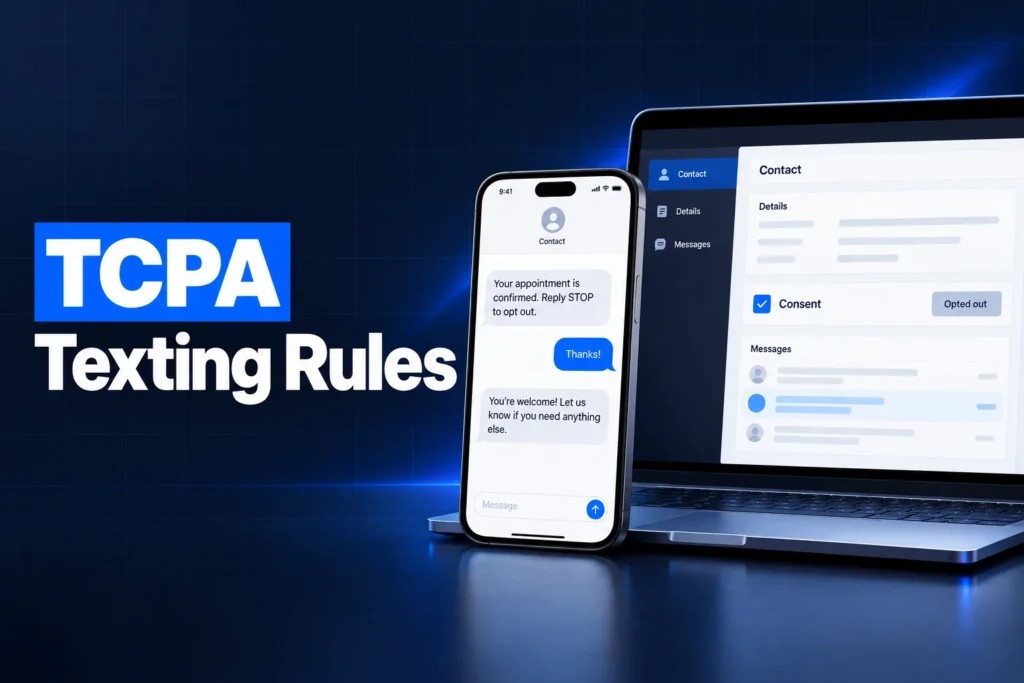
TCPA texting rules require businesses to get the right consent before sending automated texts, honor opt-outs within 10 business days, send marketing texts only between 8 a.m. and 9 p.m. in the recipient’s local time, and respect the National Do Not Call Registry. Violations carry statutory damages of $500 per message, up to $1,500 if willful.
This guide explains what the Telephone Consumer Protection Act (TCPA) covers for SMS, the consent levels, the opt-out rules the FCC changed in 2025 and 2026, how TCPA differs from A2P 10DLC carrier rules, and how to set up GoHighLevel so your texting stays compliant. It is a plain-English summary, not legal advice; confirm with counsel for your situation.
What are the TCPA texting rules?
TCPA texting rules are the federal requirements under the Telephone Consumer Protection Act of 1991 and the FCC’s rules at 47 CFR 64.1200 that govern automated and marketing text messages to US phone numbers. The FCC and federal courts treat a text message as a “call” under the TCPA.
For a business that texts customers, the rules come down to five areas:
- Consent: what permission you need before you text.
- Opt-outs: how people can revoke consent and how fast you must stop.
- Timing: the hours when marketing messages may be sent.
- Do Not Call: the national registry and your own internal do-not-contact list.
- Identification: naming your business so the recipient knows who is texting.
What consent do you need before texting customers?
Under the TCPA, marketing texts sent with an autodialer or automated system need prior express written consent, while informational texts such as appointment reminders need prior express consent. Written consent must clearly authorize marketing messages and cannot be a condition of buying anything.
For state-by-state consent rules that go beyond the TCPA, see A2P Ready’s SMS consent laws guide.
| Message type | Examples | Consent level |
|---|---|---|
| Marketing (telemarketing) | Promotions, offers, win-back campaigns | Prior express written consent |
| Informational | Appointment reminders, order updates, missed-call replies | Prior express consent |
| Two-way conversation | Replying to a customer who texted you first | The customer’s own message starts the thread; keep replies on topic |
Prior express written consent is usually captured on a web form with a checkbox and clear disclosure language next to the phone field. Our guide to SMS opt-in language shows compliant wording for forms and checkboxes.
What happened to the one-to-one consent rule?
The FCC adopted a “one-to-one” consent rule in December 2023 that would have limited each written consent to a single seller. The Eleventh Circuit vacated that rule on January 24, 2025, in Insurance Marketing Coalition v. FCC, the business day before it was due to take effect. Lead buyers should still confirm that consent clearly names them.
Does the autodialer definition still matter?
Yes, but less than it once did. In Facebook v. Duguid (2021) the Supreme Court narrowed what counts as an automatic telephone dialing system. Do Not Call rules and many state laws apply regardless of the dialer, so treat consent as required for every marketing text.
New to GoHighLevel? Try it free for 30 days
HighLevel's standard free trial is 14 days. Through our partner link you get 30 days plus HighLevel's free onboarding bootcamp. Rather have it built for you? Our US team sets up GoHighLevel accounts, websites, funnels and automations.
Partner link: we may earn a commission at no extra cost to you. Disclosure
How do TCPA opt-out and revocation rules work in 2026?
Since April 11, 2025, the TCPA lets consumers revoke consent by any reasonable method, and businesses must honor the request within 10 business days. Replies such as STOP, QUIT, END, REVOKE, OPT OUT, CANCEL or UNSUBSCRIBE are treated as valid revocations by text.
- Keywords: honor all seven standard words, even if your message only shows “Reply STOP to opt out”.
- Deadline: a reasonable time, no longer than 10 business days.
- Do Not Call requests: the internal do-not-call processing window also dropped from 30 days to 10 business days.
- No-reply numbers: if your texts cannot accept replies, each message must say so and give another way to opt out.
What changed with the “revoke all” rule?
The FCC delayed its 2024 “revoke all” requirement several times. On September 30, 2026, it adopted a new order (FCC 26-67) that replaces it: a marketing opt-out still stops all marketing texts, while an opt-out from one informational category, such as payment reminders, can apply to that category only.
The same order lets a business name one or more official opt-out methods, such as a reply keyword or a designated website or phone number, if the method is shown clearly in each message. The order takes effect 30 days after it is published in the Federal Register, so check its status before you change your opt-out language.
What hours can you send marketing texts under the TCPA?
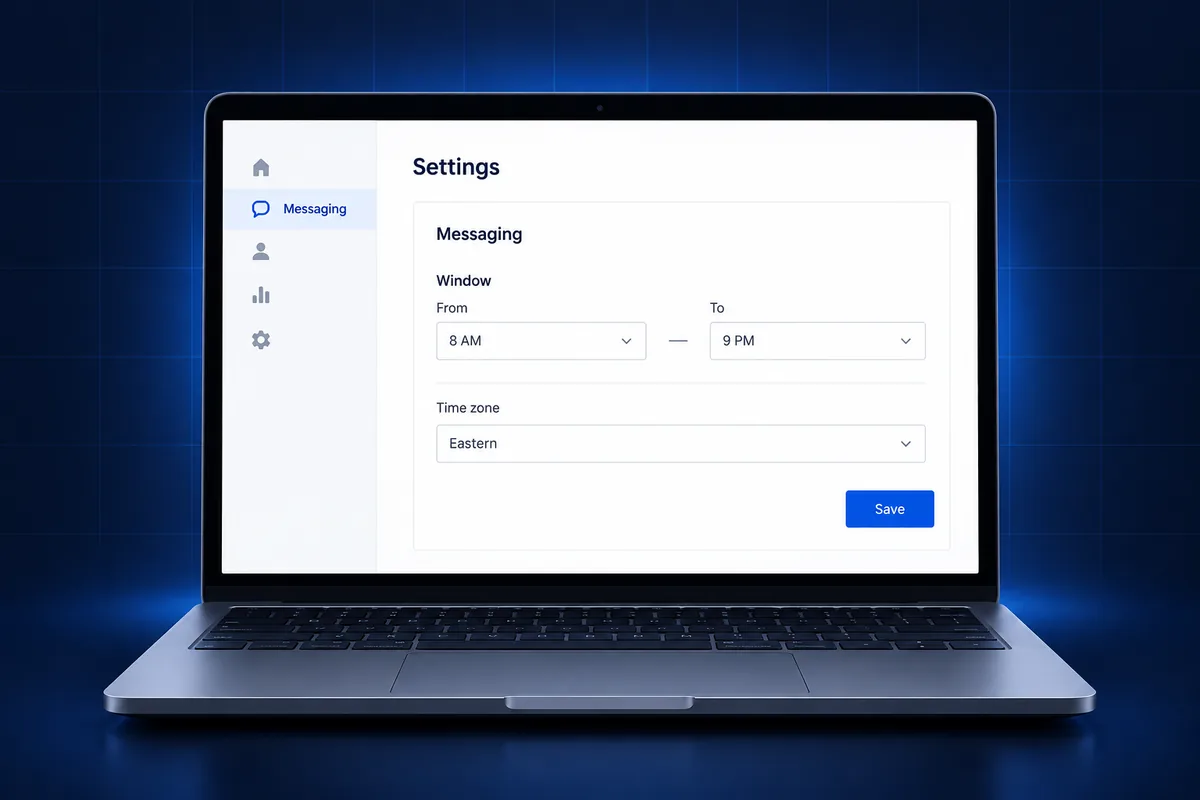
The TCPA’s federal calling-time rule bars telephone solicitations before 8 a.m. or after 9 p.m. in the recipient’s local time. Businesses apply the same window to marketing texts, and several states set tighter hours or frequency limits that also apply when you text their residents.
- Use the contact’s time zone, not your office time zone. A 9 a.m. Eastern send reaches California at 6 a.m.
- Store a time zone or full address on each contact so scheduling tools can respect local time.
- Check state rules for the states you text most. Florida’s Telephone Solicitation Act, for example, is a stricter “mini-TCPA” with its own limits.
Does the Do Not Call Registry apply to text messages?
Yes. The FCC applies National Do Not Call Registry protections to marketing text messages, so you cannot send telemarketing texts to registered numbers unless you have the person’s prior express written consent or another valid exemption, such as an established business relationship.
- Scrub marketing lists against the national registry regularly. Callers must honor new registrations within 31 days.
- Keep your own internal do-not-contact list and apply it across every sub-account and number you send from.
- Treat purchased or old lists as high risk. Consent from years ago may not cover a new marketing campaign.
Reviving an old list is still possible when consent is in place. Our database reactivation campaigns start with a consent check before any message goes out.
What are the penalties for breaking TCPA texting rules?
The TCPA lets consumers sue for $500 per unlawful text, and courts can raise that to $1,500 per message when the violation was willful or knowing. Because damages count each message, one campaign sent to a large list without valid consent can create serious exposure.
| Risk | Source | What it can mean |
|---|---|---|
| Private lawsuits and class actions | TCPA, 47 U.S.C. 227 | $500 per message, up to $1,500 if willful |
| State mini-TCPA claims | State laws such as Florida’s | Separate claims under state rules |
| Carrier filtering and suspension | Carrier and CTIA rules | Blocked messages or a suspended campaign |
| Regulatory action | FCC and state attorneys general | Fines and enforcement orders |
Florida’s 2023 amendment added a step that many businesses like: before suing over a text, a consumer must reply STOP, and the sender then has 15 days to stop texting. That makes fast, reliable STOP handling a direct legal defense.
How is TCPA different from A2P 10DLC registration?
The TCPA is federal law enforced through lawsuits and the FCC, while A2P 10DLC is a carrier system run through The Campaign Registry that decides whether your business texts get delivered at all. You need both: legal consent under the TCPA and an approved brand and campaign for 10-digit numbers.
| Question | TCPA | A2P 10DLC |
|---|---|---|
| Who sets the rules? | Congress and the FCC | US carriers and The Campaign Registry (TCR) |
| What it controls | Consent, opt-outs, hours, Do Not Call | Brand and campaign vetting, throughput, filtering |
| What failure looks like | Lawsuits and damages | Rejected campaigns and blocked texts |
| Applies to toll-free numbers? | Yes | No; toll-free uses its own verification |
Carrier reviewers check the same opt-in evidence the TCPA cares about, which is why a weak consent form often causes an A2P rejection. If you use toll-free numbers, see our guide to toll-free verification in GoHighLevel, and our GoHighLevel A2P help guide covers rejection fixes.
How do you stay TCPA compliant when texting from GoHighLevel?
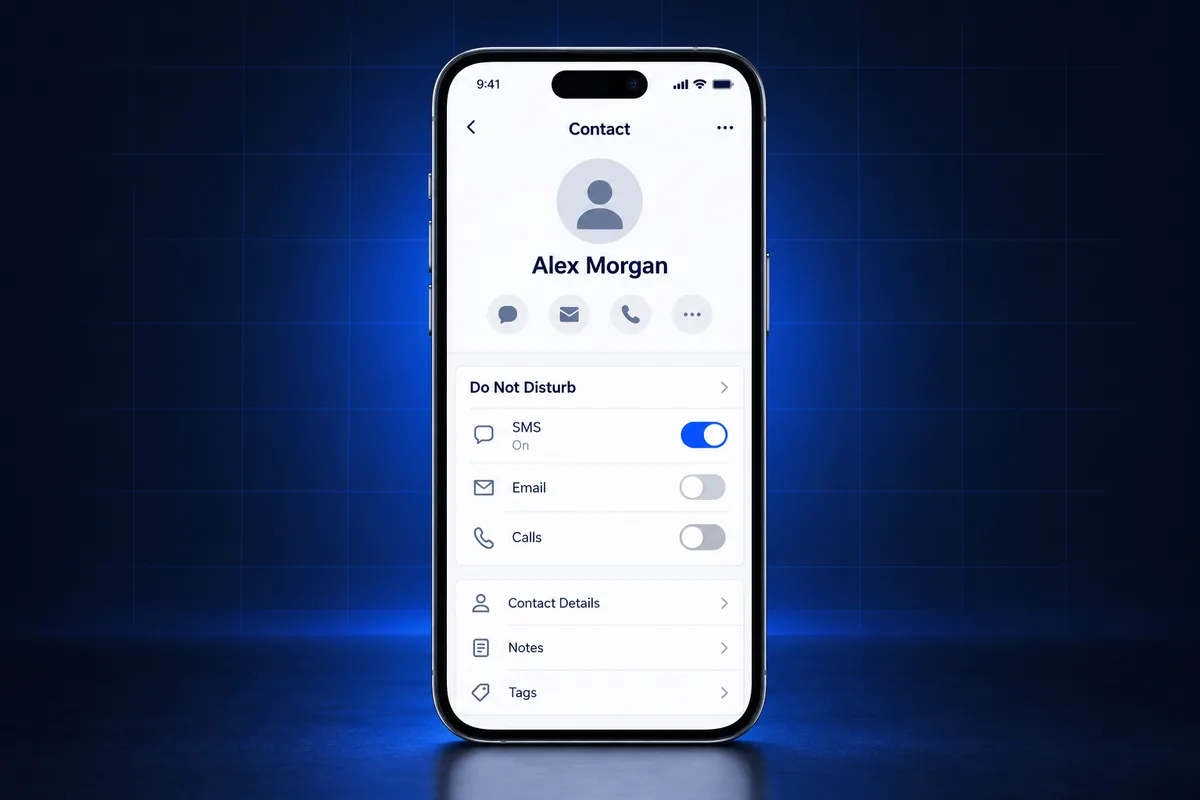
Staying TCPA compliant in GoHighLevel means capturing consent on forms, storing proof on the contact record, letting STOP replies set Do Not Disturb automatically, limiting marketing sends to local daytime hours, and keeping an approved A2P 10DLC campaign on every sub-account that texts.
- Consent capture: add a clear consent checkbox and disclosure to forms and surveys, and keep the submission record.
- Do Not Disturb: GoHighLevel can set DND per channel (SMS, email, calls and more). Opt-out keyword replies put a contact on SMS DND, and outgoing texts to DND contacts are blocked.
- Re-subscribe: a contact on permanent SMS DND from an opt-out keyword needs to reply START, or you need opt-in evidence, before texting resumes.
- Imported lists: import old opt-outs as DND before a list goes live, so nobody who unsubscribed elsewhere gets a text.
- Send windows: schedule campaigns and workflow messages for local daytime hours using the contact’s time zone.
- Identify yourself: include your business name in the first message of every conversation.
Automated replies such as missed-call text-back are usually informational, but keep them free of promotions so they stay in the informational category.
Want your GoHighLevel texting set up the compliant way?
TCPA risk and A2P rejections usually come from the same gaps: vague opt-in wording, missing privacy and terms pages, and STOP replies that are not honored across numbers. Fixing them before you send protects both delivery and your business.
We handle A2P 10DLC registration and SMS compliance for GoHighLevel for a $50 flat service charge, with carrier fees passed through, including a review of your opt-in forms and website. If a past freelancer left broken workflows or lists without consent records, our sub-account audit and rebuild cleans that up first.
Frequently Asked Questions
Does the TCPA apply to text messages?
Yes. The FCC and federal courts treat text messages as calls under the Telephone Consumer Protection Act. That means consent, opt-out, calling-time and Do Not Call rules apply to SMS just as they apply to automated phone calls, and each unlawful text can count as a separate violation for damages.
What time can you legally send marketing texts?
Federal TCPA rules bar telephone solicitations before 8 a.m. or after 9 p.m. in the recipient’s local time, and businesses apply that window to marketing texts. Some states set stricter hours, so if you text residents of states with mini-TCPA laws, follow the tighter limit for those contacts.
How fast must you honor a STOP reply?
Within a reasonable time, and no later than 10 business days, under the FCC revocation rule in force since April 11, 2025. In practice, systems like GoHighLevel stop texts immediately when a contact replies STOP, which is the safest approach and matters under state laws such as Florida’s.
Can you text customers who already bought from you?
You can send informational texts about their purchase or appointment with prior express consent, such as a phone number they gave you for that purpose. Marketing texts sent with automated tools still need prior express written consent, and a purchase cannot be conditioned on agreeing to marketing texts.
Is A2P 10DLC registration enough to comply with the TCPA?
No. A2P 10DLC registration through The Campaign Registry lets carriers deliver your texts, but it does not prove consent. You still need valid opt-in records, working opt-outs, respect for calling hours and Do Not Call scrubbing to meet the TCPA.
What is the penalty for a TCPA texting violation?
Consumers can recover $500 per unlawful text, and courts can award up to $1,500 per message for willful or knowing violations. Class actions multiply those amounts across every recipient, and state mini-TCPA laws and carrier suspensions can add separate consequences on top.