
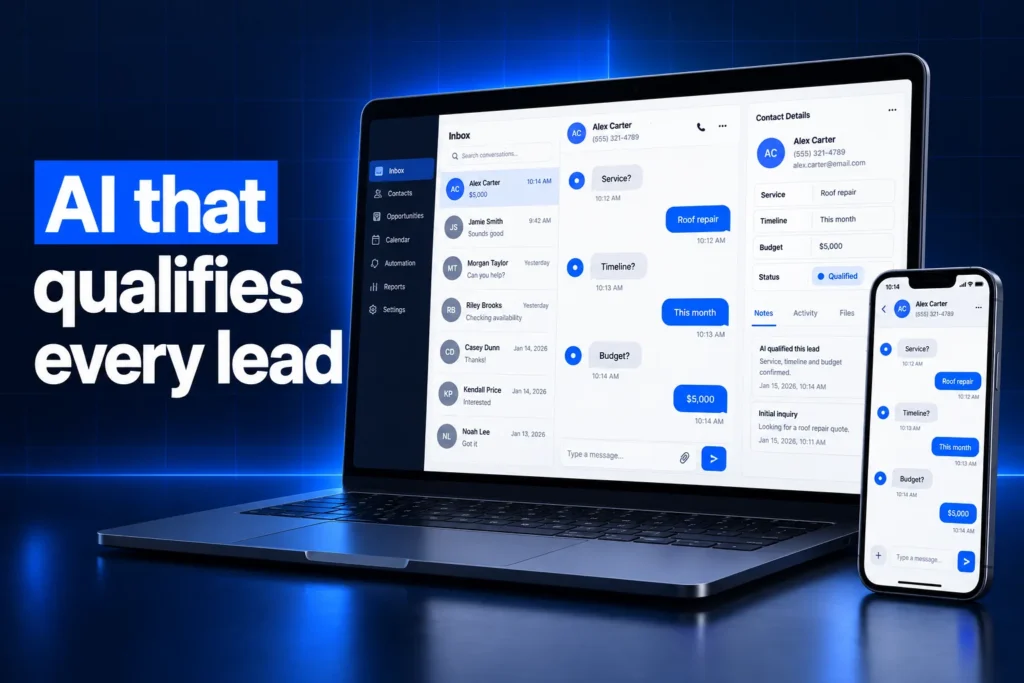
GoHighLevel AI lead qualification uses HighLevel’s AI agents to ask new leads your qualifying questions, save the answers to contact fields, and then book, route or hand off each lead. Conversation AI qualifies by text and chat; Voice AI qualifies by phone. Both run inside the sub-account, so every answer lands in the CRM.
This guide explains what AI qualification can and can’t do in GoHighLevel, how Conversation AI and Voice AI compare for qualifying, which questions to ask, how booking and human handoff work, what it costs, and the compliance guardrails US businesses need. It is written for owners and agencies deciding whether an AI SDR is worth setting up.
What does GoHighLevel AI lead qualification do?
GoHighLevel AI lead qualification turns a first conversation into structured data. An AI agent asks the questions you define, maps each answer to a contact field, skips anything the CRM already knows, and then takes the next step: booking an appointment, triggering a workflow, or alerting a person on your team.
HighLevel describes Conversation AI as able to ask questions, collect information and move contacts toward the right next step. In a qualification setup, that means:
- Instant first response: the agent replies the moment a lead texts, chats or calls, which is the core of speed-to-lead.
- Consistent questions: every lead hears the same qualifying questions in the same order, not whatever a busy rep remembers.
- Clean CRM data: answers go into mapped contact fields, so pipelines, smart lists and reports can use them.
- A decision at the end: qualified leads get booked or routed; poor fits get a polite answer and a tag instead of a sales call.
What it doesn’t do is judge a deal the way an experienced closer does. The AI follows your rules. If the rules are vague, the qualification will be vague too.
Conversation AI vs Voice AI: which should qualify your leads?
Conversation AI is the better qualifier for leads who text, chat or message you, while Voice AI is better for leads who call. Most US service businesses get both kinds of leads, so the usual answer is one agent per channel, both writing to the same contact fields and pipeline.
| Factor | Conversation AI | Voice AI |
|---|---|---|
| Channels | SMS, web chat and other supported messaging channels | Inbound and outbound phone calls, plus a Voice AI chat widget |
| Where it lives | AI Agents, then Conversation AI | AI Agents, then Voice AI |
| How it saves answers | Bot Goals map each question to a contact field | Update Contact Field action, during or after the call |
| Booking | Appointment Booking goal on a configured calendar | Book Appointment action during the call |
| Handing off | Human Handover action, email notifications, workflows | Call Transfer to a person, or Agent Transfer to another AI agent |
| Requirements | A2P 10DLC registration for business texting on US numbers | LC Phone or Twilio numbers only |
| Usage measured in | AI agent responses | AI agent minutes |
Conversation AI also has a Suggestive mode, where the agent drafts replies and a person sends them. That is a safe way to test qualification questions before letting the agent reply on its own.
New to GoHighLevel? Try it free for 30 days
HighLevel's standard free trial is 14 days. Through our partner link you get 30 days plus HighLevel's free onboarding bootcamp. Rather have it built for you? Our US team sets up GoHighLevel accounts, websites, funnels and automations.
Partner link: we may earn a commission at no extra cost to you. Disclosure
Which questions should an AI agent qualify on?
An AI agent should qualify on the few facts that decide whether a lead is worth a sales conversation: what they need, where they are, when they need it, and whether budget or authority fits. Three to five questions is usually enough. Every extra question costs replies and makes the lead feel interrogated.
A practical question set for a US service business:
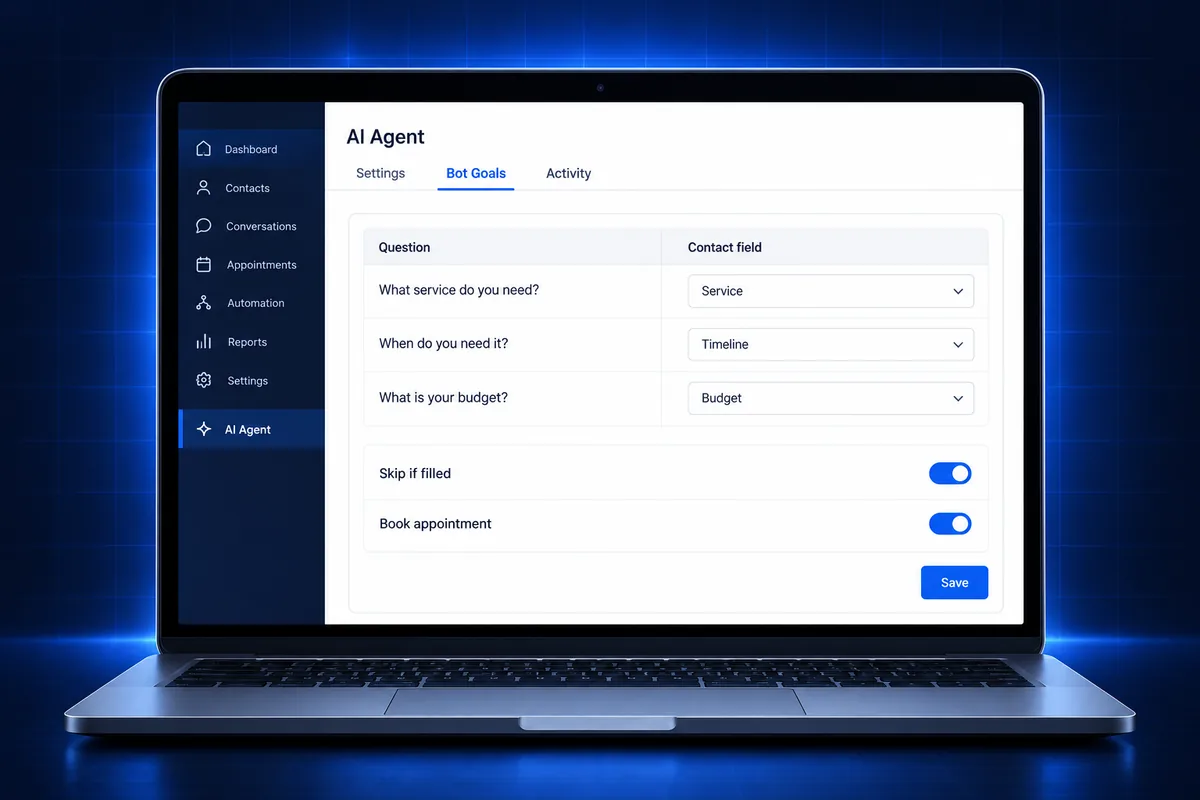
- Need: which service are you interested in? Map it to a dropdown field so reports stay clean.
- Location: what city or ZIP are you in? This filters out leads outside your service area.
- Timeline: when do you want this done? “This week” and “just researching” deserve different follow-up.
- Fit: a budget range or project size question, phrased as ranges rather than an open number.
- Decision: are you the person who decides? Useful for B2B and high-ticket offers.
HighLevel’s Bot Goals support standard fields such as name, email, phone, street address and city, plus custom questions or objectives. Turn on Skip if Already Filled so the agent doesn’t ask a returning lead for an email address the CRM already holds. HighLevel also notes that a question with no mapped contact field may still be asked, but the answer may not update the contact record, so map every question.
How does the AI book qualified leads automatically?
A GoHighLevel AI agent books qualified leads through a connected calendar. In Conversation AI, you turn on the Appointment Booking goal and choose a calendar that is already configured. In Voice AI, you add a Book Appointment action. Either way, booking depends on that calendar’s availability, routing and appointment settings.
Three setup decisions shape how well booking works:
- Book only after qualification: instruct the agent to offer times only once the required answers are collected. Otherwise, it will happily book poor-fit leads.
- Pick the right calendar type: a team calendar with round robin spreads booked calls across reps; a personal calendar sends everything to one person.
- Confirm and remind: booked appointments should trigger confirmations and reminders, so qualified leads actually show up.
If booking is your main goal and qualification is light, compare this with our guide to the AI appointment setter vs a human setter. For phones answered around the clock, see the GoHighLevel AI receptionist.
How does handoff to a human work?
Handoff to a human in GoHighLevel works differently by channel. Conversation AI can use a Human Handover action, email notifications and workflow triggers to bring in a team member. Voice AI uses Call Transfer, which sends the live call to a person’s phone number. Agent Transfer moves a call to another AI agent, not a human.
Define handoff rules before launch. Good triggers for a human include:
- The lead asks for a person, or is clearly frustrated.
- The lead is qualified and high value, so a rep should take over now.
- The question involves pricing exceptions, contracts, legal or medical details.
- The agent doesn’t know the answer. HighLevel’s email notification setting can alert your team when that happens.
Turn on Conversation Summary so the person taking over sees what the lead already said. For Voice AI, HighLevel merges post-call data, workflows and notifications from every agent involved in a transferred call, so downstream automations get the full picture.
Speed still matters after the handoff. A lead the AI qualified at 9 p.m. should get a notification and a fast human follow-up, and missed calls should get a text back. That’s what our missed-call text-back and speed-to-lead system covers.
What guardrails and compliance rules apply?
AI qualification in GoHighLevel must follow the same US texting and calling rules as a human rep. Business texts on US local numbers need A2P 10DLC registration through The Campaign Registry, texting needs consent, and outbound calls that use an AI-generated voice fall under the TCPA’s artificial voice rules, according to the FCC.
- Register before you text: unregistered 10DLC traffic gets filtered or blocked by carriers. We handle A2P 10DLC registration for a $50 flat service charge, with carrier fees passed through.
- Consent and opt-out: only text leads who opted in, and honor STOP requests. Our guide to TCPA texting rules covers the basics.
- Outbound AI calls: get the right consent before an AI agent calls a lead.
- Tell the agent what not to say: no promised prices, no guarantees, no legal or medical advice. Put these limits in the agent’s instructions.
- Review the logs: Conversation AI and Voice AI keep agent and call logs, and audit logs record when an agent is turned on, off, paused or reassigned.
This is general information, not legal advice. Confirm consent and calling rules for your situation with counsel.
What does AI lead qualification cost in GoHighLevel?
GoHighLevel AI lead qualification is billed per sub-account. Without an AI Employee plan, Conversation AI and Voice AI are pay-per-use. HighLevel’s AI Employee Growth plan is $50 a month with 1,000 Conversation AI responses and 100 Voice AI minutes, and the Unlimited plan is $97 a month, subject to fair use.
| Option | Conversation AI | Voice AI |
|---|---|---|
| No AI Employee plan | Pay-per-use | Pay-per-use |
| AI Employee Starter ($20/month, $497 Founder plan agencies only) | Not included, pay-per-use | Not included, pay-per-use |
| AI Employee Growth ($50/month) | 1,000 agent responses a month | 100 agent minutes a month |
| AI Employee Unlimited ($97/month) | Unlimited, fair use | Unlimited, fair use |
Two details catch people out. When an included allowance runs out, extra usage is paused by default until the agency enables Extra Usage. And phone system charges for calls and texts are billed separately, whatever the AI plan. HighLevel notes that AI pricing can change, so confirm the in-app pricing before you quote a client.
How do you measure AI qualification quality?
Measure AI qualification by outcomes, not message counts: how many conversations end with every required field filled, how many qualified leads book, how many booked leads show, and how often reps disagree with the AI’s call. Review agent logs weekly in the first month and tighten the prompts.
- Completion: build a smart list of contacts the agent spoke to with qualification fields still empty. A long list means questions are being skipped or not mapped.
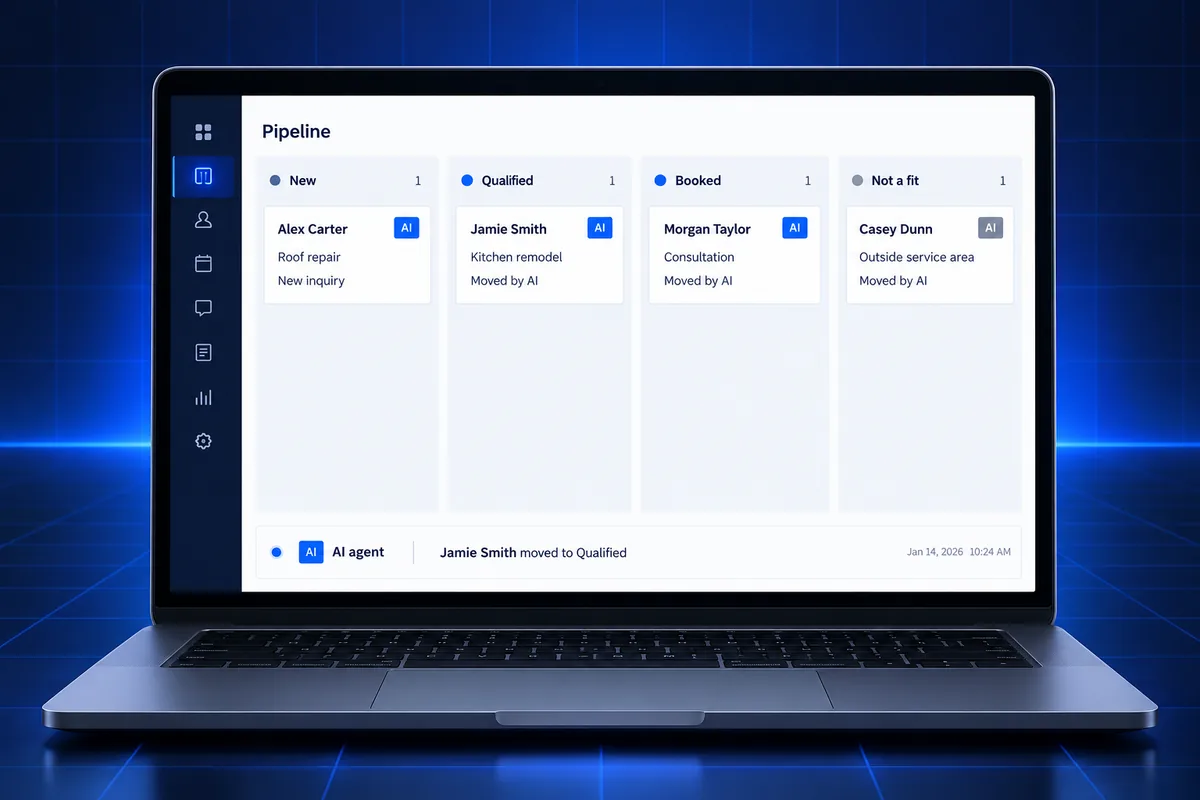
- Pipeline movement: use a stage such as Qualified or Not a fit, and compare it with what reps decide after the first call.
- Show rate: if AI-booked appointments no-show more than rep-booked ones, the agent is booking too early.
- Transcripts: read a sample of conversations and calls each week. Look for wrong answers, awkward phrasing and missed handoffs.
- Prompt Optimizer: HighLevel offers prompt optimizers for both Conversation AI and Voice AI to test and refine agent instructions.
Want it built for you? Our Voice AI and Conversation AI setup service configures qualifying questions, field mapping, booking, handoff rules and reporting inside your GoHighLevel account. Plans and setup ranges are on our services and pricing page.
Frequently Asked Questions
Can GoHighLevel AI qualify leads on its own?
Yes. In Autopilot mode, a Conversation AI agent replies on its own, asks the questions set in its Bot Goals, saves answers to contact fields and can book appointments or trigger workflows. Voice AI does the same on phone calls. Most teams start in Suggestive mode, where a person approves each reply, then switch once the answers look right.
What is an AI SDR in GoHighLevel?
An AI SDR is an AI agent doing a sales development rep’s first job: replying to new leads, asking qualifying questions and booking meetings for closers. In GoHighLevel that role is filled by Conversation AI for text and chat and Voice AI for calls, connected to your calendars, pipeline and workflows inside the same sub-account.
How many qualifying questions should the AI ask?
Ask three to five questions that actually change what happens next, such as service needed, location, timeline and budget range. Each extra question adds a reply the lead might not send. Turn on Skip if Already Filled so returning contacts aren’t asked for details the CRM already has, and map every question to a field.
Does Voice AI need LC Phone to qualify callers?
HighLevel says Voice AI only works on accounts using LC Phone or Twilio numbers. If your sub-account uses another provider, Voice AI won’t answer those calls. Phone system charges for the calls still apply separately from any AI Employee plan, so include both the AI usage and the call minutes when you estimate costs.
Do I need A2P 10DLC registration for AI texting?
Yes, if the AI agent texts US contacts from a local 10DLC number. Carriers treat AI-written business texts like any other application-to-person traffic, so the brand and campaign must be registered through The Campaign Registry. Without registration, messages can be filtered or blocked, and the qualification conversation never reaches the lead.
Can the AI hand a lead to a human mid-conversation?
Yes. Conversation AI has a Human Handover action and can email your team when it can’t answer. Voice AI can transfer a live call to a person’s phone number with Call Transfer, or to another AI agent with Agent Transfer. Set clear handoff rules, such as a request for a person or a high-value lead.